
Radicand · TechGuidr product
Radicand: Get beneath the answer
Start from evidence, end with your judgement.
Your most valuable knowledge sits in research, reports, contracts and data that most AI tools cannot see, or cannot show their working on. Radicand works across your documents and structured data together. It answers with a citation on every point, runs the research, comparison and briefing workflows your experts repeat, and keeps permissions and expert review built in. Anyone can open the source and check it before acting on it.
Where expert time goes
From searching to judging
People start from an evidence-backed first answer, then spend their time challenging it, adding judgement and deciding what matters.
The old way
- Find the relevant material
- Work out which version is current
- Read across several sources
- Find the numbers
- Reconstruct the firm’s position
- Draft the answer
- Check the evidence
- Then apply judgement
With Radicand
- Ask the real question
- Start from an evidence-backed synthesis across the relevant knowledge and data
- Open and challenge the sources
- Apply expert judgement
- Approve, edit or continue the workflow
Experts spend more of their time being experts
From the production deployment
Most of the way to a useful answer, quickly
One piece of feedback from the production deployment was that the system could get an expert roughly 80% of the way to the answer quickly. The remaining 20% is where expert judgement belongs.
What the business told us, in substance
- It makes economists’ jobs easier
- Less time finding and reconstructing what the firm already knows
- More of the experts’ time on judgement and the final part of the answer
- A change in how the work can be done, beyond a better way to search
Themes from the business’s feedback, in our words rather than quoted. Time saved has not been measured against a baseline, so we do not put a figure on it.
Read the case studyOurs or yours
As our product, or inside your own environment
Use Radicand as the product, or use what we learned building it to create the capability inside your own environment.
Our product
Radicand as the product
Start from the platform we already run in production, configured around your organisation and the way it works.
We configure it around your
- Data and knowledge
- Terminology and domain
- Permissions
- People and workflows
- Branding and integrations
- Evaluation requirements
Usually the faster route to a working environment, because the platform already runs in production.
Your environment
The Radicand architecture, in your environment
For organisations that do not want another product: we build the capability in your own estate, with the patterns proven in Radicand.
Depending on what you run, for example
- Azure, AWS or Google Cloud
- AI Foundry, Bedrock or Vertex AI
- Fabric or Databricks
- Your search and vector stores
- Your security and data controls
- Your operating model and support
None of these is required. You own and run the deployment; rights in TechGuidr components are agreed in the contract, not transferred by default.
Radicand is just one possible option
If Microsoft Copilot, ChatGPT, a platform you already run, another product or a bespoke build is the better answer, we recommend that instead and say why. Our interest in Radicand is always disclosed.
What it does
Knowledge, data and the work, with the evidence in view
Knowledge
Publications, research, contracts, policies and technical documentation.
Data
Forecasts, metrics, time series and lakehouse tables, read with the documents that explain them.
Workflow
Research, comparison, briefings and recurring intelligence, shaped around the work.
Evidence
Sources on each claim, with changed and conflicting positions surfaced.
Human control
Permissions, guardrails, and expert review where the work needs it.
The same pattern in different organisations
- A research firmResearch publications + Forecasts + Datasetsbecomes Analysis, comparison and client briefings
- A professional services firmContracts + Precedent + Structured client databecomes Evidence-backed analysis and review workflows
- A workforce teamEmployee data + Policies + Regulatory requirementsbecomes Workforce analysis and review workflows
- An engineering teamRFCs + Telemetry + Architecture informationbecomes Technical analysis and decision support
Patterns, not customer stories. The research firm is the production deployment above; the others are configured on demo environments.
Why Radicand. In maths, the radicand is the value beneath the root sign. Every answer has something beneath it. Radicand shows you what.
In production
- In use daily
- in production for the research business it was built around
- 78,500+
- publications and 25 years of research
- 35,700
- structured forecast data points, used alongside the documents
- 89,000
- chart assets, approximately, processed alongside the publications
Editions
One platform, set up for each domain
Eight editions, each with its own sources, taxonomy, starter questions and look. Choose one to see its real screen, or see where each is used by industry.
Radicand Default
The general configuration for research publications, forecasting and analysis: answers, search, summaries and comparison, with the sources shown.
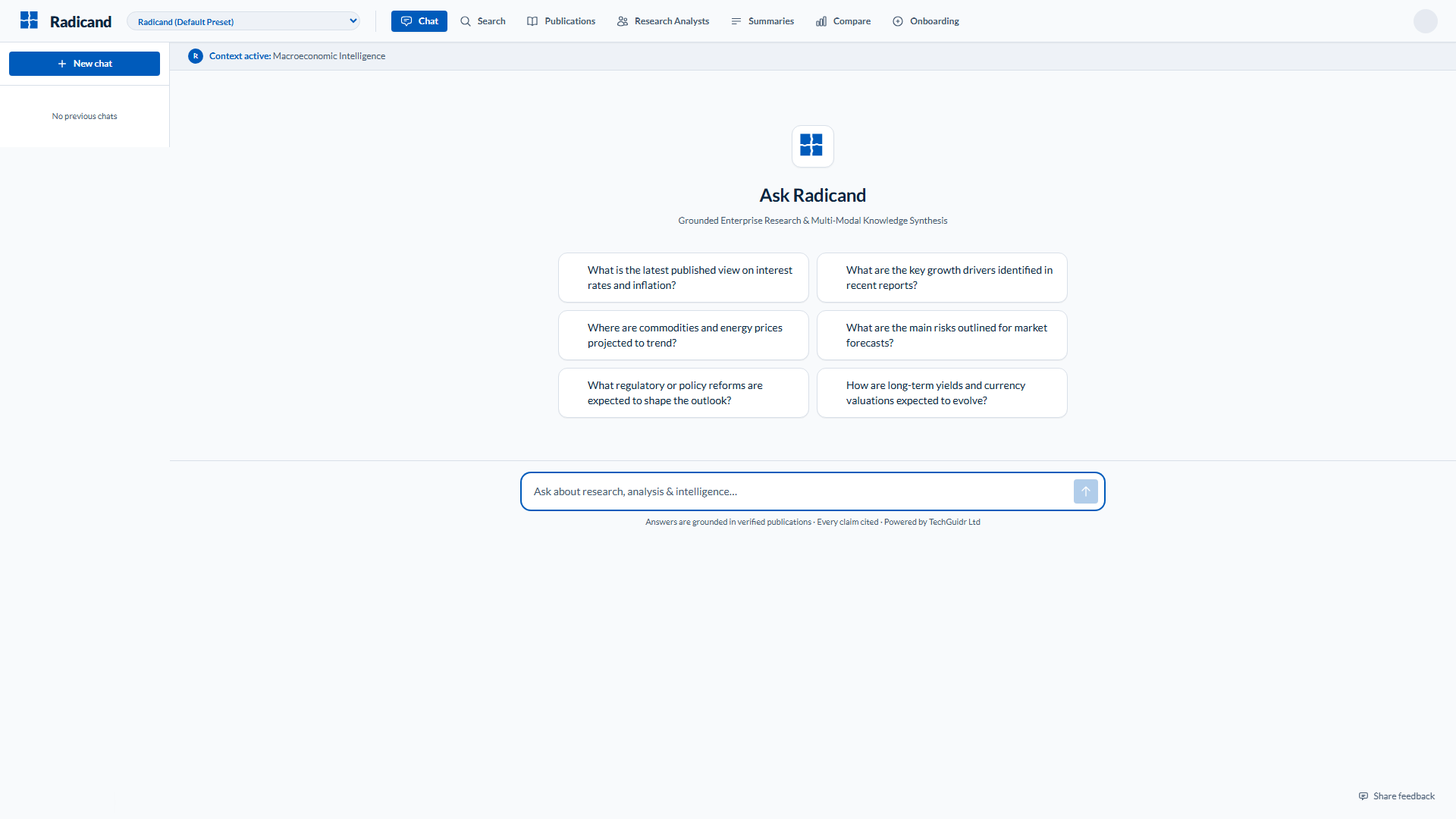 (opens the screen full size in a new tab)
How it works
From a question to the source behind the answer
A question followed through Radicand's default edition for research publications, from the opening screen to the sources and the library behind them. Every edition shows its evidence the same way.
(opens the screen full size in a new tab)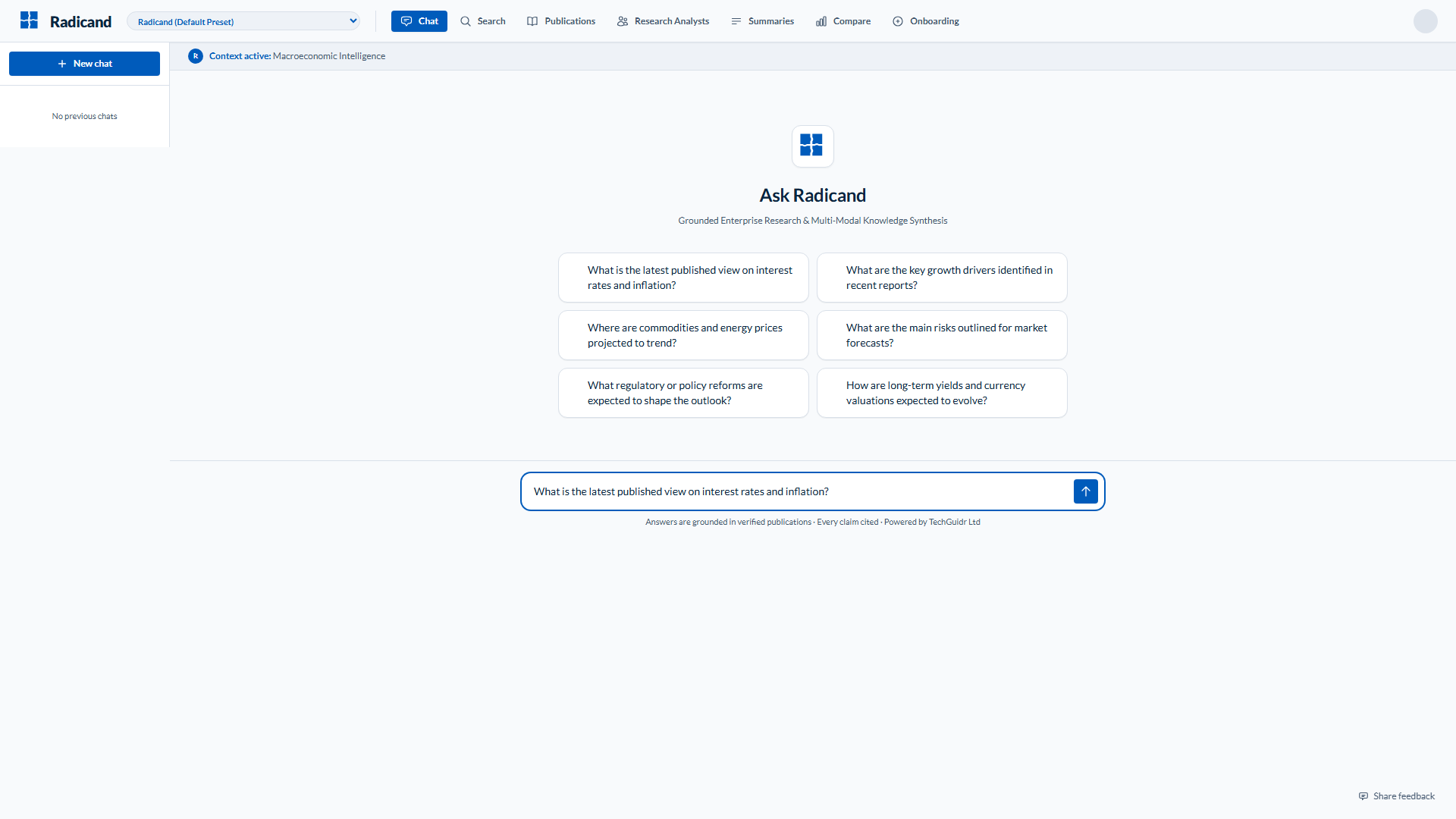 (opens the screen full size in a new tab)
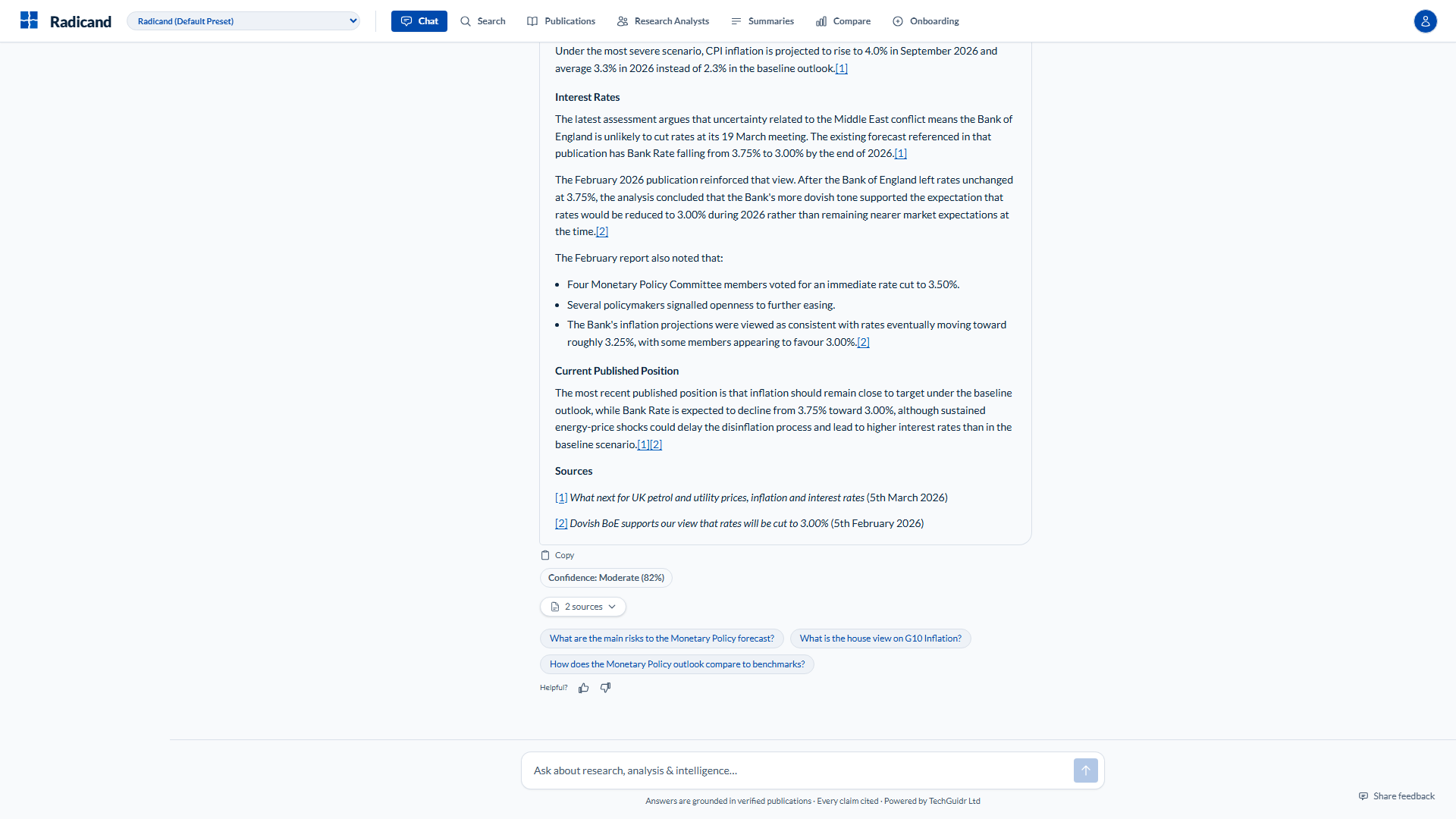 (opens the screen full size in a new tab)
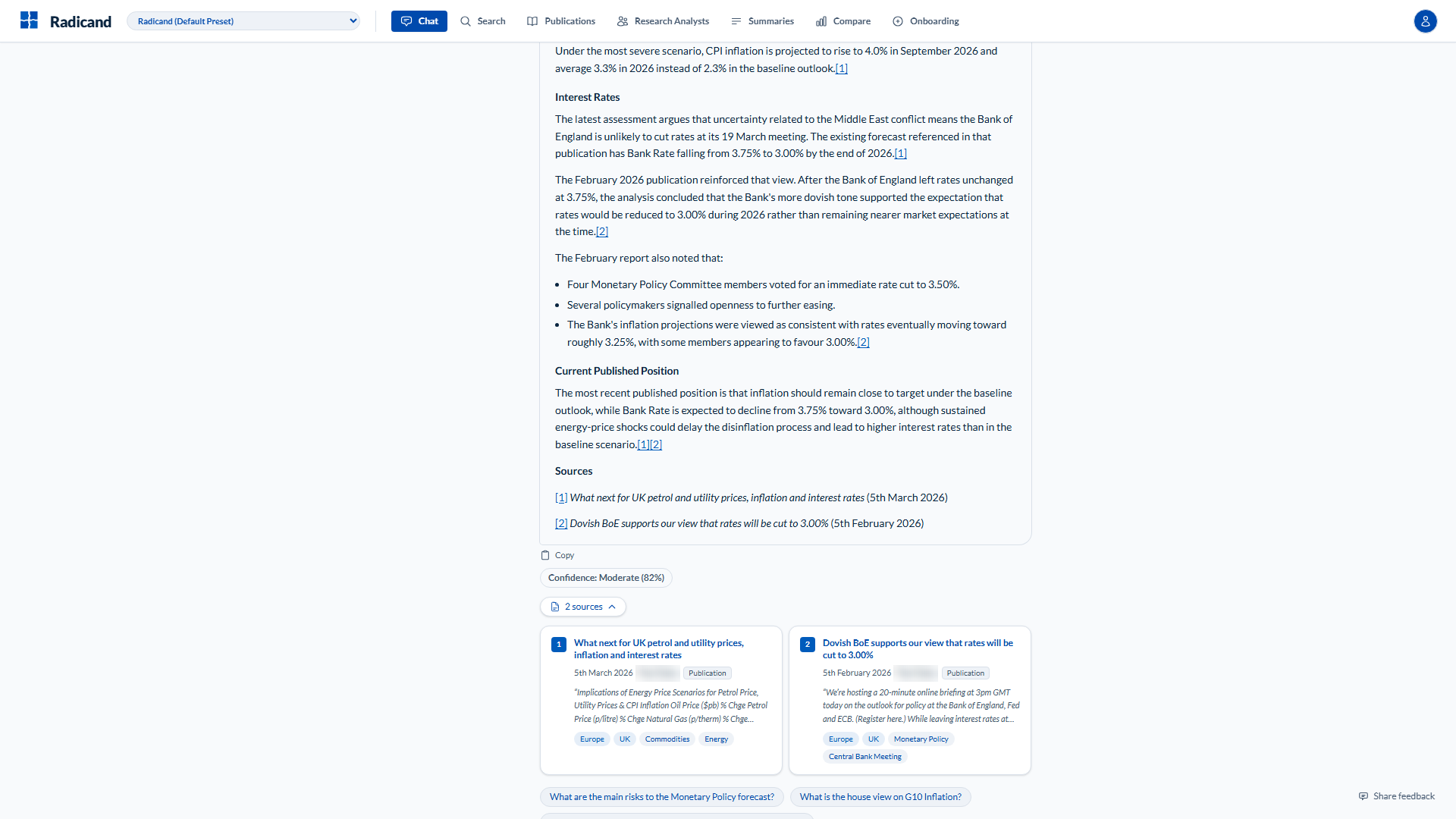 (opens the screen full size in a new tab)
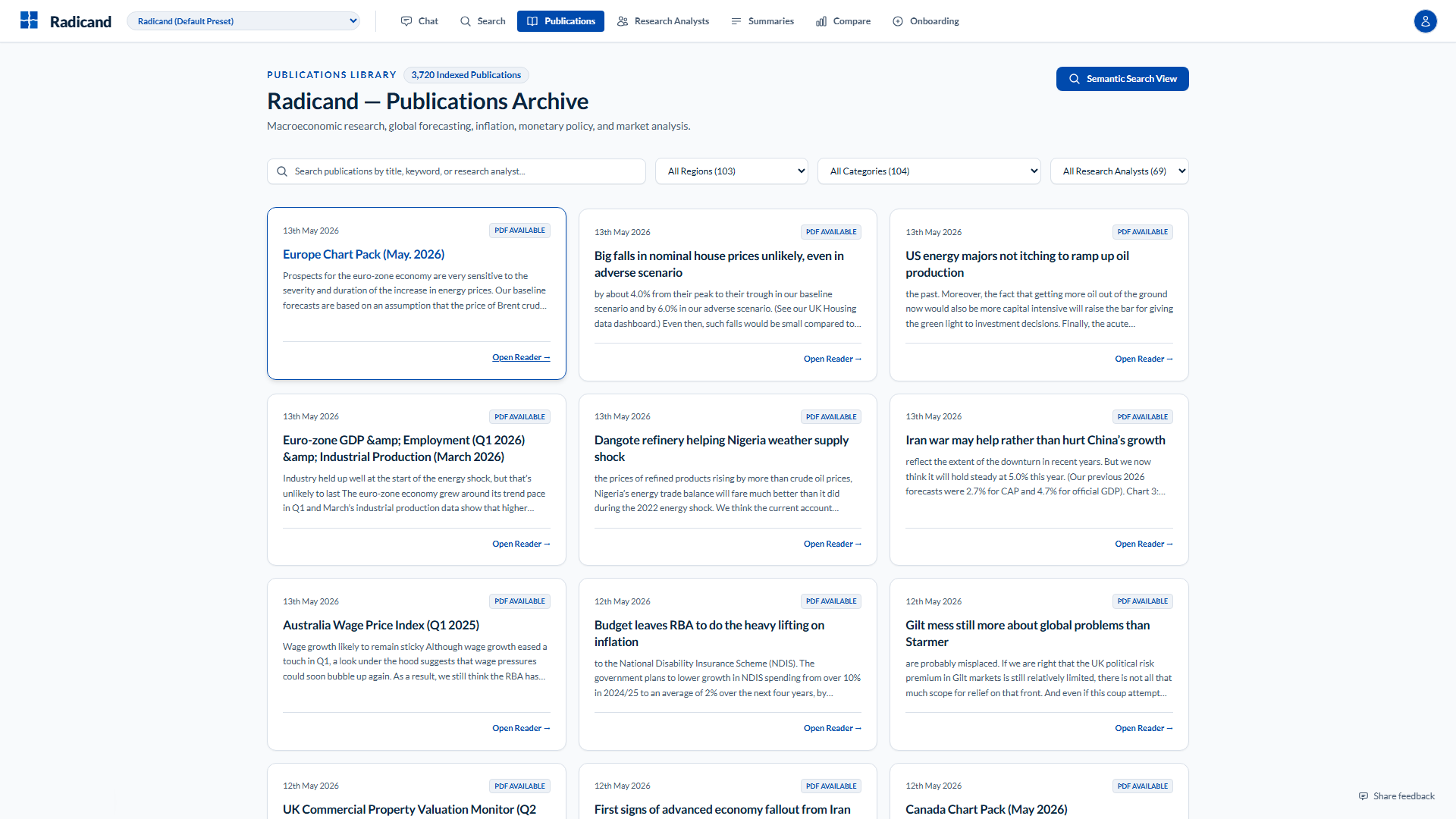 (opens the screen full size in a new tab)
Real product screens from demo environments. Organisation and author names in them are fictional, and the figures show how the product answers, not findings.
Beyond documents
Workforce data and documents, analysed together
Radicand Talent sets workforce data on pay, hiring, learning and screening against the policies and regulation it is judged by. Shown on a fictional organisation with demo data.
 (opens the screen full size in a new tab)
 (opens the screen full size in a new tab)
 (opens the screen full size in a new tab)
 (opens the screen full size in a new tab)
 (opens the screen full size in a new tab)
Real product screens from demo environments. Organisation and author names in them are fictional, and the figures show how the product answers, not findings.
Tenant & Branding Studio
Configured per tenant, switched at runtime
Each tenant’s branding, taxonomy, search index and system prompts are set here, and the organisation’s knowledge is brought in before anyone asks a question.
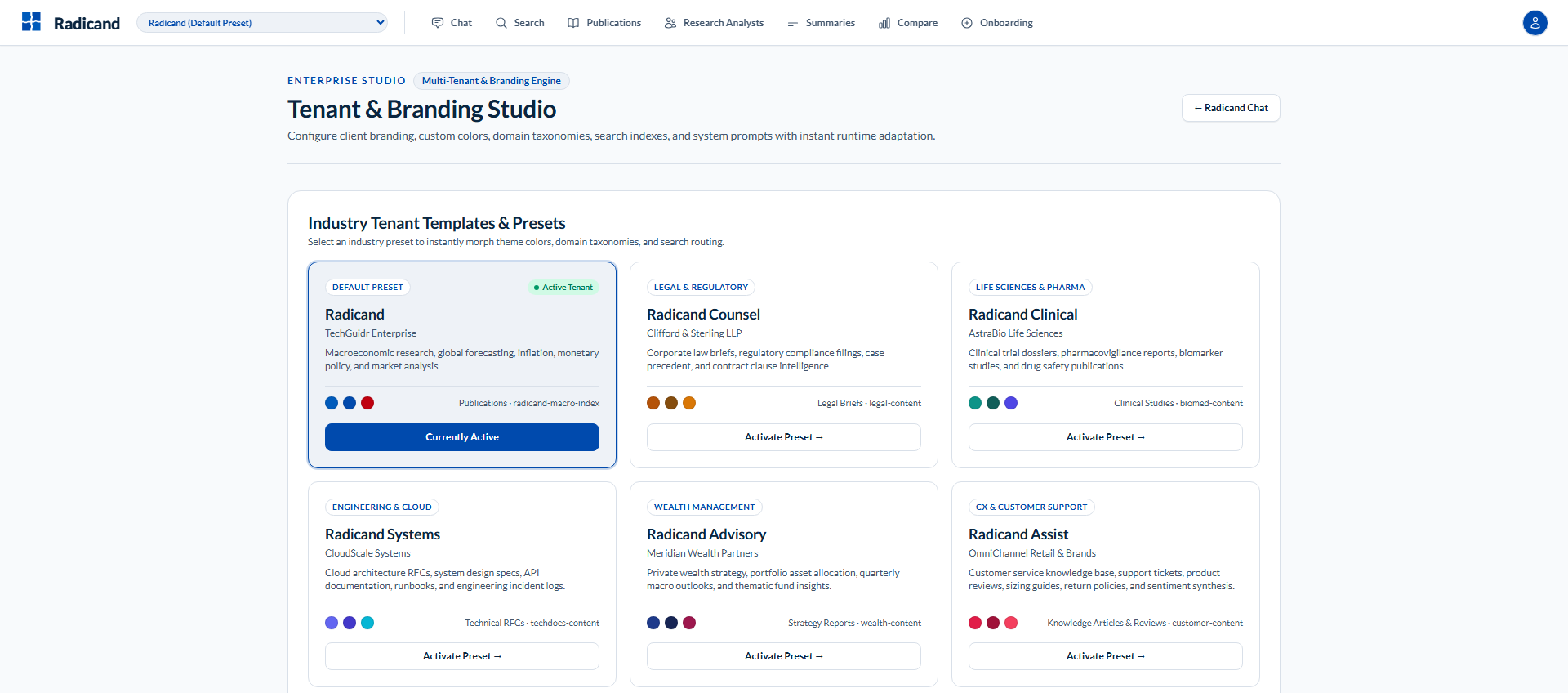 (opens the screen full size in a new tab)
Connect and ingest the documents and data
Configure chunking and search for each kind of content
Set who can see which collections
Choose the domain configuration and its guardrails
Shape the views and workflows each group needs
Capabilities
What it takes to trust AI with your knowledge and data
Your knowledge and data, brought in
- Documents, publications and institutional knowledge, with structured data: forecasts, metrics, time series and lakehouse tables
- Connectors and a data architecture designed around your sources
- A searchable library, filtered by region, category and author
Analysis people can check
- Comparison across documents, datasets and time, with changed and conflicting positions surfaced for an expert to judge
- Structured answers, with tables where the question calls for them
- Numbered citations on each point, a confidence rating, and a reader that opens the full source
Built into the work
- Executive briefings, summaries and recurring intelligence workflows
- Observatories and decision views over structured data
- Defined operational and agentic workflows, with expert review and approval
- Integration into existing enterprise systems
Control where it matters
- Permissions that follow who may see what
- Domain guardrails, personas and system instructions
- Evaluation and validation designed in, with separate grounding checks where configured
- Separate configurations per tenant and domain, set up in the Studio
For technical buyers
Under the bonnet, retrieval, synthesis and validation run as separate stages, orchestrated with tool use where a workflow needs it. Retrieval combines keyword and vector search with semantic reranking, tuned per collection in Azure AI Search. Recency and supersession rules keep current views apart from older ones, and a separate grounding check tests the answer against its sources.
How we engage
From a review to a workflow in use
Radicand fits inside the same commercial ladder as the rest of our AI work.
AI Work Review
from £7,50010 working days
Ten working days: where expert time and value leak, the top three opportunities, readiness, controls, economics and a prioritised roadmap.
AI Work Sprint
from £25,000Typically 4 to 6 weeks
One working workflow on your own information, with citations, permissions, expert review, evaluation and before-and-after measurement.
AI Work Programme
from £60,000Scoped to the function
Scale a proven workflow across a function or the business, on shared foundations.
Managed Improvement
from £5,000Per month
Ongoing evaluation, new workflows, model changes, optimisation and governance, monthly.
Questions
What buyers ask first
What is Radicand?
Radicand is TechGuidr’s AI working environment for proprietary knowledge and data. It puts an organisation’s documents and structured data side by side, so people can research, analyse, compare, brief and act with the evidence in view, under the organisation’s own permissions. It is in production and daily use at a research business with more than 78,500 publications.
Do we have to buy another platform?
No. You can use Radicand as our product, configured around your organisation, or we can build the same architecture inside your own environment, on Azure, AWS or Google Cloud, with the data and AI services you already use, for example Microsoft Fabric, Databricks, AI Foundry, Amazon Bedrock or Vertex AI. We can support other platforms as well. If Copilot, ChatGPT, a platform you already run or another product is the better answer, we recommend that.
How is it different from a chatbot over our documents?
It answers questions with cited sources, and it also does the work around the answer: comparison across documents, data and time, briefings, recurring intelligence workflows, decision views over structured data, and expert review and approval. Permissions, domain guardrails and evaluation are part of the configuration.
Can the answers be wrong?
Yes, as with any AI system. Radicand shows the sources so each claim can be checked, can run a separate grounding or confidence check where configured, and leaves the final judgement with an accountable expert.
Who owns it if you build it in our environment?
You own and run the deployment. Rights in any TechGuidr components it uses are agreed in the contract rather than transferred by default.
Where do we start?
Usually with an AI Work Review, from £7,500, to find the workflow worth changing, then an AI Work Sprint, from £25,000, to prove it on your own information. A working session on demo content is a useful first conversation.
See Radicand in action
A working session in the edition closest to your work, on demo content, and a conversation about what it would take on your own information.