
Retail runs on fast decisions made from slow, scattered data
Range, price, promotion, stock and service decisions depend on store, digital, supply-chain and customer data that rarely sits in one place. We fix the data underneath and put AI where the commercial value can be measured.
The problems
What gets in the way of good trading decisions
Forecasts nobody fully trusts
Demand forecasts are overridden by hand because the inputs are late, partial or disputed.
Range and product decisions on partial data
Buying and range decisions are made without a single view of sales, returns, margin and availability.
No single view of the customer
Store, online, app and service each see a different customer.
Promotions that cost margin
Promotions are judged on volume, while the margin and the stock consequences arrive later.
Stock you cannot see
Inventory across stores, warehouses and suppliers does not reconcile, so losses and availability gaps are found late.
Store and digital data that do not join up
Footfall, transactions, web and app behaviour live in separate systems with separate definitions.
Supply-chain visibility
Lead times, supplier performance and inbound stock arrive by email and spreadsheet.
Customer service knowledge
Agents search policies, product information and past cases to give an answer that should be instant and consistent.
Product content at scale
Descriptions, attributes and imagery for thousands of lines take time and drift out of date.
Systems that grew by acquisition
Growth and acquisitions left several ERPs, tills and data stores that each tell part of the story.
Forcing events
When it usually comes to a head
- A trading season that exposed the gaps in stock or forecast data
- An acquisition or new channel adding another set of systems
- Margin pressure that makes promotion and pricing decisions matter more
- A board asking what AI agents will actually return, in pounds
- Replatforming the ERP, e-commerce or point of sale
What you already hold
The knowledge and data involved
- Point-of-sale and e-commerce transactions
- Stock, warehouse and supply-chain data
- Product master data, attributes and content
- Customer, loyalty and service records
- Promotional calendars, pricing and margin
- Policies, returns rules and service knowledge
Workflows
Workflows we change
Specific pieces of recurring work, each with an owner, a baseline and a measure of what changed.
Demand forecasting
Forecasts built on joined-up sales, stock and promotional data, with the overrides recorded and learned from.
Range and product decisions
Range reviews with sales, margin, returns and availability in one view.
Promotion and margin analysis
Promotions judged on margin and stock as well as volume, before and after they run.
Stock and inventory visibility
Stock reconciled across locations, with losses traced to their causes.
Customer service answers
Agents given the approved answer from policies, product information and resolved cases, cited.
Product content
Product descriptions and attributes drafted from the product data for a person to approve.
Trading insight
Weekly trading questions answered from the data, with the figures traceable to source.
Where AI earns its place
AI opportunities
Agents with a measured commercial case
AI agents for trading, service or content, each with a baseline and a measure in pounds before it scales.
Service answers that are consistent
Customer service grounded in approved policy and product information, cited, with the agent in control.
Product content at speed
Descriptions and attributes drafted from product data, checked by a person before publishing.
Trading questions answered from the data
Natural-language questions over curated trading data, with the figures traceable.
What usually sits underneath
When AI disappoints, the cause is usually the data, systems and ownership beneath it, so we look there too.
- Product, customer and location data held differently in each system
- Several ERPs or tills after growth and acquisitions
- Store and digital data with different definitions of a sale or a customer
- Batch reporting that arrives after the decision has been made
- Data platforms that cost more each year without answering more questions
Broader technology and data work
- Data platform design and modernisation on Azure and Databricks
- Integration after acquisitions or replatforming
- Independent review of a forecasting, CDP or AI vendor
- Technology due diligence on a retail acquisition
What we could build or change
Examples of the work
Illustrations of what an engagement could produce, scoped to your own information and measured against a baseline.
- A trading data model that reconciles store, digital and stock data
- A customer service assistant grounded in policy and product information
- A product content workflow that drafts from product data for approval
- A promotion analysis that shows the margin and stock effect, not only volume
Answerable
Answerable Assist for customer service
Answerable Assist is set up for customer service: knowledge base, support tickets, product reviews, sizing guides and return policies. The screen shows it answering how to handle an exchange for the wrong size, with the guide behind the answer.
See every configurationAnswerable Assist: CX & Customer Support
Set up for customer service: knowledge base, support tickets, product reviews, sizing guides and return policies.
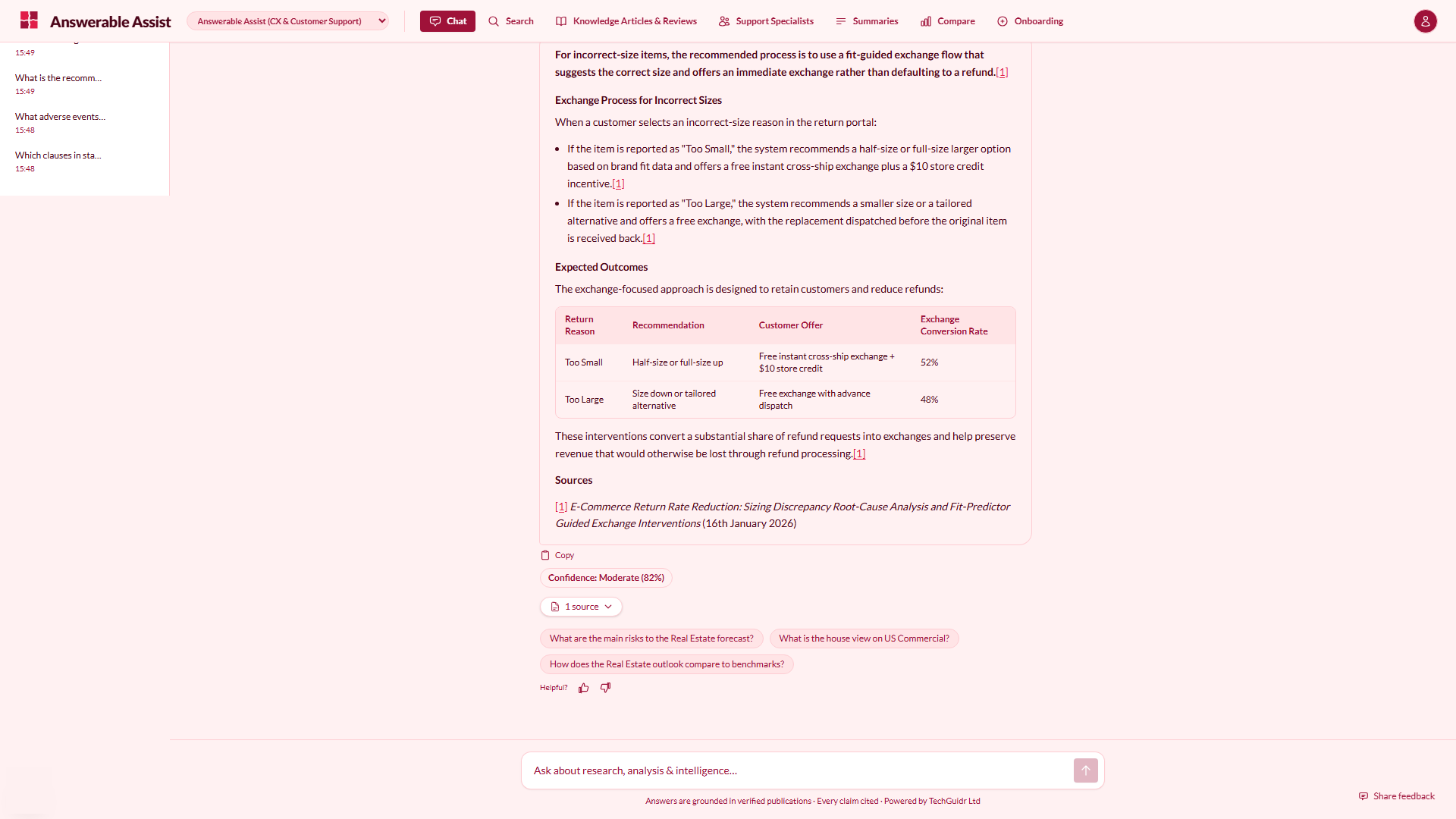 (opens the screen full size in a new tab)
Proof
What we have built and done
Each item says where it comes from: TechGuidr’s own products, the founder’s earlier roles or demonstration configurations.
- Founder’s earlier role
Global Data & AI Lead, Microsoft Retail & Consumer Goods
From 2022 to 2025 Dan was Global Data & AI Lead in the solutions team for Microsoft’s Retail & Consumer Goods business. This is experience from an earlier role, not TechGuidr client work.
- Founder’s earlier role
Finding where the stock was going
For a leading UK retailer, a data warehouse built around the events where losses clustered, so unexplained stock losses could be traced to causes. Delivered in an earlier role.
See earlier work - Founder’s earlier role
Donated goods tracked from bag to till
For a national charity’s retail operation, a greenfield Azure data platform connecting legacy point-of-sale terminals and IoT tracking across vehicles, textile banks and bags. Delivered in an earlier role.
See earlier work - Demonstration configuration
Answerable Assist: CX & Customer Support
A configuration for customer service answers from policies, product information and resolved cases, shown on illustrative content.
See the configurations
How we engage
Where to start
Every engagement starts from the decision or outcome you need. Prices are starting points and exclude VAT.
- AI Work Reviewfrom £7,500Ten working days: where expert time and value leak, the top three opportunities, readiness, controls, economics and a prioritised roadmap.
- AI Work Sprintfrom £25,000One working workflow on your own information, with citations, permissions, expert review, evaluation and before-and-after measurement.
- Discoveryfrom £7,500Findings, options and a recommendation as a standalone deliverable. Typically one to three weeks.
- Build & Productionisefrom £15,000AI, data and software systems built and taken into production, in working increments. Larger builds scoped in phases.
- Fix & Optimisefrom £10,000Root-cause diagnosis and a recovery plan. Remediation is a separate, agreed scope.
- Technology Due Diligencefrom £10,000Independent technology, data and AI assessment with a red-flag report to an agreed timetable.
Industries
Related industries
- Professional servicesLegal, accounting, consulting and specialist advisory firms whose product is expert time and judgement.Explore professional services
- Manufacturing & industrialManufacturers, engineering and industrial businesses running plants, sites and complex products.Explore manufacturing & industrial
- Technology & softwareSoftware, SaaS and technology businesses building AI into products and platforms that need to scale.Explore technology & software
Bring the trading question nobody can answer quickly
We will tell you what sits underneath it and whether AI, better data or a process change is the right first move.