
From AI product idea to a platform that scales
Software and technology businesses need AI in the product, data customers can trust and platforms that keep up with growth. We bring product thinking, architecture and hands-on engineering to design, build, productionise and modernise.
The problems
What slows technology businesses down
Product strategy for AI
Pressure to add AI to the product without a clear view of what customers will pay for.
AI product design
Features that demo well but fail on real customer data, edge cases or cost.
Data products
Valuable data that could be a product, held in a shape customers cannot use.
Prototype to production
Pilots that never reach production because evaluation, security and cost were left until last.
Scaling
Architecture that worked for the first customers strains under growth.
Platform modernisation
Legacy services, middleware and data stores slow every release.
Product telemetry
Usage data collected but not turned into product decisions.
Customer knowledge and support
Support teams answer from documentation, tickets and engineers’ memory.
Acquisition and integration
Acquired products bring different stacks, data and teams.
Engineering knowledge
Architecture decisions and runbooks are hard to find when they matter.
Forcing events
When it usually comes to a head
- Investors or the board asking for an AI roadmap
- A competitor shipping an AI feature
- Infrastructure cost rising faster than revenue
- A funding round, acquisition or due diligence
- Enterprise customers asking about AI security and data handling
What you already hold
The knowledge and data involved
- Product documentation and help content
- Support tickets and resolutions
- Product telemetry and usage data
- Architecture decisions, runbooks and incident reviews
- Customer contracts and requirements
- Code repositories and technical specifications
Workflows
Workflows we change
Specific pieces of recurring work, each with an owner, a baseline and a measure of what changed.
AI features in the product
Designed, evaluated and costed before launch, with guardrails and monitoring.
Support and customer knowledge
Support answers grounded in documentation and resolved tickets, cited.
Engineering knowledge
Runbooks, architecture decisions and incident history answerable for engineers.
Product analytics
Telemetry turned into the product decisions it was collected for.
Release and operations
Evaluation and monitoring that make AI features safe to change.
Where AI earns its place
AI opportunities
AI product features that survive production
Designed with evaluation, cost and guardrails from the start.
Support that answers from the product’s own knowledge
Consistent, cited answers for support teams and customers.
Engineering knowledge on hand
Engineers find the decision, the runbook or the past incident in seconds.
Data products
The data the business holds, shaped into something customers will pay for.
What usually sits underneath
When AI disappoints, the cause is usually the data, systems and ownership beneath it, so we look there too.
- Middleware and services added faster than they were designed
- Data stores that grew with each feature
- No evaluation or monitoring for AI behaviour
- Cloud cost without clear ownership
Broader technology and data work
- Architecture and platform modernisation
- Data platforms and lakehouses
- Technology due diligence for investors and acquirers
- Fractional CTO or head of data leadership
What we could build or change
Examples of the work
Illustrations of what an engagement could produce, scoped to your own information and measured against a baseline.
- An AI feature taken from prototype to production with evaluation and monitoring
- A support assistant grounded in documentation and resolved tickets
- An engineering knowledge assistant over runbooks and decisions
- A platform rebuilt around a lakehouse to cut latency and cost
Answerable
Answerable Systems and Assist
Systems makes engineering knowledge answerable for the people who run the platform: RFCs, specifications, runbooks and incident logs. Assist does the same for support teams. Both are shown on real screens from demonstration environments.
See every configurationAnswerable Systems: Engineering & Cloud
Set up for engineering teams: architecture RFCs, design specifications, API documentation, runbooks and incident logs.
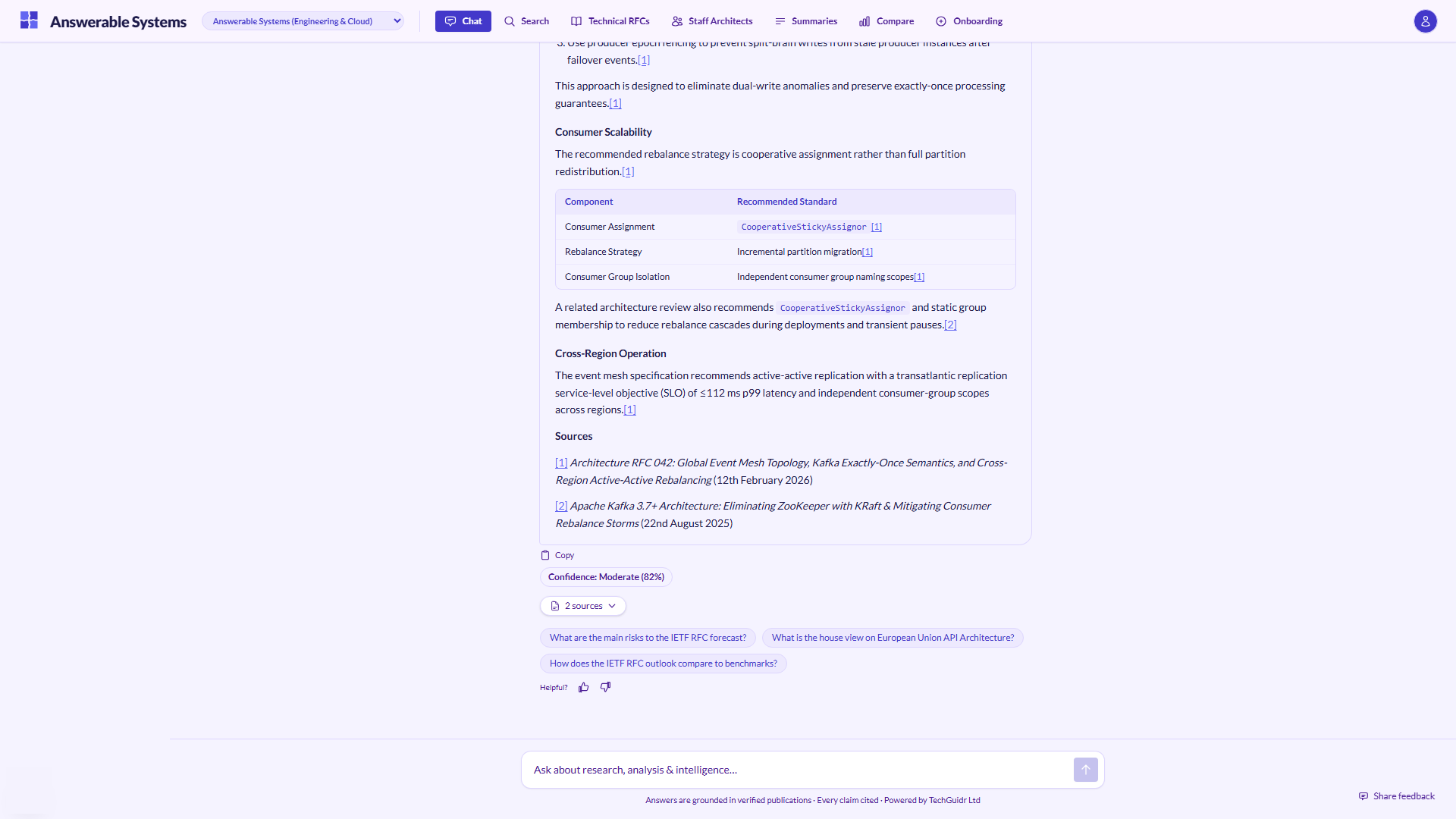 (opens the screen full size in a new tab)
Proof
What we have built and done
Each item says where it comes from: TechGuidr’s own products, the founder’s earlier roles or demonstration configurations.
- TechGuidr product
Two AI products built from scratch
TechGuidr conceived, designed, architected and built Answerable and Bearing: the product thinking, architecture, engineering, data foundations, AI implementation and delivery. Both are in production.
Read the case study - Founder’s earlier role
A SaaS platform and its iOS and Android apps, rebuilt
Delivered by Dan in an earlier technology leadership role: the SaaS application and its mobile apps rebuilt around a Databricks lakehouse, with AI performance coaches embedded. Dashboard queries went from four to five seconds to under 600 milliseconds.
Read the case study - Demonstration configuration
Answerable Systems and Assist
Configurations for engineering knowledge and customer support, shown on illustrative content.
See the configurations
How we engage
Where to start
Every engagement starts from the decision or outcome you need. Prices are starting points and exclude VAT.
- Build & Productionisefrom £15,000AI, data and software systems built and taken into production, in working increments. Larger builds scoped in phases.
- AI Work Sprintfrom £25,000One working workflow on your own information, with citations, permissions, expert review, evaluation and before-and-after measurement.
- Fix & Optimisefrom £10,000Root-cause diagnosis and a recovery plan. Remediation is a separate, agreed scope.
- Technology Due Diligencefrom £10,000Independent technology, data and AI assessment with a red-flag report to an agreed timetable.
- Leadership as a Servicefrom £7,500 a monthSenior technology, data and AI leadership on an agreed monthly remit. Full-time placement is separate.
- Independent Reviewfrom £7,500Independent challenge of a proposal, architecture, AI programme or business case. The answer can be "don't".
Industries
Related industries
- Research & insightResearch firms, analysts, market and economic intelligence, proprietary data businesses and specialist advisers.Explore research & insight
- Manufacturing & industrialManufacturers, engineering and industrial businesses running plants, sites and complex products.Explore manufacturing & industrial
- Gaming & interactiveGames studios, publishers and interactive entertainment businesses.Explore gaming & interactive
Bring the feature, the platform or the cost that worries you
We will tell you what it would take to make it work in production, and what it should cost to run.